Sixty years of the Tashkent Agreement: A pact that ended a war but left lasting questions

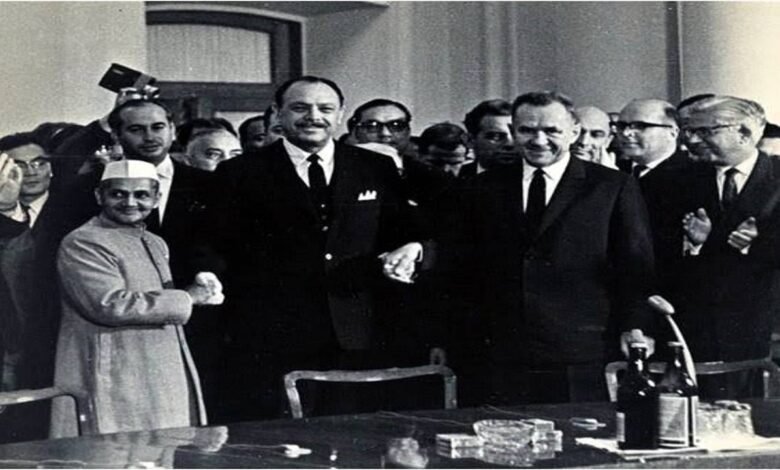
New Delhi / Tashkent, : Sixty years ago, on January 10, 1966, India and Pakistan signed the historic Tashkent Agreement, bringing an official end to the 1965 India–Pakistan war. Brokered through the mediation of the United States and, more decisively, the Soviet Union, the agreement aimed to restore peace in South Asia. However, the pact is remembered as much for its unresolved issues as for the shock that followed it—the mysterious death of then Prime Minister Lal Bahadur Shastri in Tashkent just hours after signing the agreement.
The 1965 war between India and Pakistan was one of the most intense conflicts in South Asia after Independence and is often described as part of the prolonged Cold War–era standoff in the region. The immediate trigger was Pakistan’s “Operation Gibraltar,” launched in April 1965, which sought to infiltrate forces into Jammu and Kashmir to incite unrest. India responded militarily, escalating the conflict into a full-scale war by September.
For 17 days, until September 23, 1965, fierce battles were fought on multiple fronts. The Indian Army not only repelled Pakistani advances in Kashmir but also crossed the international border, pushing close to Lahore. The conflict marked one of the first large-scale uses of tanks after World War II, underlining the intensity of the fighting. With casualties mounting and the risk of a wider regional crisis increasing, global powers stepped in to prevent further escalation.

Soviet Premier Alexei Kosygin played a crucial role in mediating between the two rivals. The venue chosen was Tashkent, then part of the Soviet Union and now in Uzbekistan. From January 4 to January 10, 1966, intensive negotiations took place between Indian Prime Minister Lal Bahadur Shastri, Pakistani President Mohammad Ayub Khan, and Kosygin. The outcome was the Tashkent Declaration, commonly referred to as the Tashkent Agreement.
Under the agreement, both countries committed to restoring diplomatic relations and normalising ties. India and Pakistan agreed to withdraw their armed forces to positions held before August 5, 1965, with a deadline set for February 25, 1966. They reaffirmed their commitment to resolving disputes through peaceful means, without the use of force, and pledged adherence to United Nations principles. The agreement also provided for the release of prisoners of war, the resumption of diplomatic missions, and the promotion of cultural and economic exchanges.
Despite these provisions, a major point of contention remained conspicuously absent from the talks: Kashmir. The core issue that had triggered the war was neither substantively discussed nor resolved. While the agreement formally ended hostilities and restored a semblance of peace, critics argue that the failure to address Kashmir sowed the seeds for future conflict, eventually culminating in the 1971 war.
The political impact of the agreement was immediate and dramatic, particularly in Pakistan. President Ayub Khan faced intense criticism at home, with dissent emerging within his own administration. Zulfikar Ali Bhutto resigned from the government soon after and later went on to found the Pakistan Peoples Party, reshaping Pakistan’s political landscape.
In India, the agreement was overshadowed by tragedy. Just hours after signing the pact, on January 11, 1966, Prime Minister Lal Bahadur Shastri died suddenly in Tashkent at the age of 61. The official cause was stated as a heart attack, but the absence of a post-mortem examination at the place of death and reports of unexplained marks on his body triggered widespread speculation and controversy. Even decades later, the exact circumstances surrounding his death remain a subject of debate.
Shastri’s death was a profound shock to the nation. Known for his simplicity, integrity, and firm leadership during wartime, he had become a symbol of unity and resolve. His sudden demise turned a diplomatic milestone into a moment of national mourning.
Six decades on, the Tashkent Agreement continues to occupy a complex place in the histories of both India and Pakistan. While some view it as a necessary compromise that prevented further bloodshed, others regard it as an incomplete settlement that postponed, rather than resolved, the fundamental disputes between the two neighbours.