‘Hijab-wearing daughter can become Prime Minister one day’, says Owaisi; sparks political debate

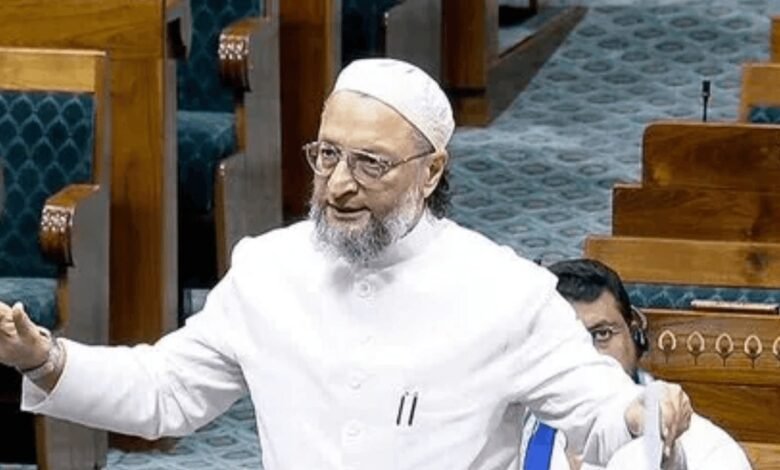
New Delhi :AIMIM president Asaduddin Owaisi on Friday said that the Indian Constitution provides equal opportunity to every citizen to rise to the highest office in the country, expressing confidence that a “hijab-wearing daughter” could one day become the Prime Minister of India. His remarks, made during an election rally in Maharashtra’s Solapur ahead of the January 15 local body polls, have triggered sharp political reactions from the Bharatiya Janata Party (BJP).
Addressing supporters, Owaisi drew a comparison between the constitutional frameworks of India and Pakistan to underline what he described as the inclusive and secular nature of the Indian Constitution. He said Pakistan’s Constitution restricts the posts of Prime Minister and President to followers of a particular religion, whereas the Constitution drafted under the leadership of Dr B R Ambedkar guarantees equal rights and opportunities to all citizens, irrespective of faith.
“In Pakistan, the Constitution says only a person belonging to one religion can become the Prime Minister or President. But the Constitution written by Dr Babasaheb Ambedkar clearly states that any citizen of this country can become the Prime Minister, a Chief Minister or even a Mayor,” Owaisi said. “By the grace of the Almighty, either today or in some future generation, a day will come when a hijab-wearing daughter will become the Prime Minister of India,” the AIMIM chief added.

Targeting the BJP, Owaisi said he was confident that what he termed as “politics of hate” against Muslims would not sustain in the long run. “The hatred you are spreading against Muslims will not last forever. That day will surely come. Those who spread hate will fade away, and when love becomes normal, people will realise how their minds were poisoned,” he said.
Owaisi also criticised what he called increasing hostility towards minorities, warning that such polarising politics could weaken the democratic fabric of the country. His remarks came at a time when election campaigning has intensified in Maharashtra, with civic body polls scheduled for January 15 and results expected the following day.
The BJP was quick to hit back. Party MP Anil Bonde accused Owaisi of making irresponsible statements and presenting only “half-truths” to the public. Bonde claimed that many Muslim women themselves oppose the hijab, arguing that no one wants to live under subjugation. He further cited protests by women in Iran against mandatory hijab rules to support his argument.
Bonde also raised the issue of what he called a “population imbalance” in India and urged Hindus to unite. His comments added another layer of controversy to an already polarised debate around religion, identity and constitutional values.
Responding sharply, BJP national spokesperson Shehzad Poonawalla challenged Owaisi to reflect his stated ideals within his own party. In a post on X, Poonawalla said, “Miyan Owaisi says a hijab-wearing woman can become the Prime Minister. The Constitution does not stop anyone. But I challenge you — first appoint a Pasmanda or a hijab-wearing woman as the president of AIMIM.”
Separately, Owaisi also took aim at former Union Home Minister P Chidambaram over amendments to the Unlawful Activities (Prevention) Act (UAPA). He alleged that the changes to the law have resulted in undertrial prisoners languishing in jail for prolonged periods without conviction, raising serious concerns about civil liberties.
Owaisi’s remarks, delivered amid an intense election campaign in Maharashtra, have once again brought questions of constitutional values, minority rights and political rhetoric to the centre of national discourse.