FASTag May Soon Be Replaced by MLFF Toll System In India
The Ministry of Road Transport and Highways (MoRTH) are preparing to transform the country's highway toll collection system by introducing the Multi-Lane Free-Flow (MLFF) tolling technology.

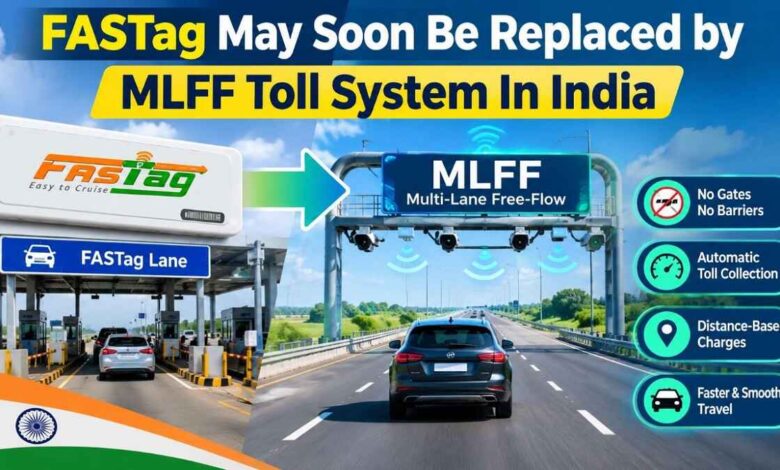
The National Highways Authority of India (NHAI) and the Ministry of Road Transport and Highways (MoRTH) are preparing to transform the country’s highway toll collection system by introducing the Multi-Lane Free-Flow (MLFF) tolling technology. FASTag May Soon Be Replaced by MLFF Toll System In India.
The proposed system is expected to gradually replace the existing FASTag mechanism, enabling seamless and barrier-free toll collection. The new technology is designed to improve traffic flow, reduce congestion at toll plazas, and enhance toll revenue collection by allowing vehicles to travel without stopping.
MLFF Toll Collection System:
Multi-Lane Free-Flow (MLFF) is a modern, barrier-less toll collection system that allows vehicles to pass through tolling points at normal highway speeds without stopping or slowing down.


Unlike conventional toll plazas, the MLFF system does not require physical gates or barriers. Toll charges are automatically calculated and deducted while vehicles remain in motion.
Automatic Number Plate Recognition (ANPR):
The MLFF system uses Automatic Number Plate Recognition (ANPR) technology, where high-resolution cameras installed above highways identify a vehicle’s registration number. The toll amount is then automatically deducted from the linked account without requiring the vehicle to stop.
The system also incorporates Global Navigation Satellite System (GNSS) technology to calculate the exact distance travelled by a vehicle on the highway. Instead of paying a fixed toll for an entire stretch, motorists will be charged only for the distance they actually use, following a pay-as-you-use model.
MLFF vs FASTag Difference:
Under the current FASTag system, vehicles must pass through designated toll lanes where RFID scanners read the FASTag before the barrier opens. Although the process is faster than manual toll collection, vehicles are still required to slow down or briefly stop.
In contrast, the MLFF system eliminates physical toll plazas altogether. Vehicles travelling at speeds of 80 to 100 km/h can continue uninterrupted while toll charges are automatically processed.
Benefits of the MLFF System:
Time and Fuel Savings
By eliminating queues at toll plazas, motorists can save considerable time and reduce fuel consumption caused by frequent stopping and starting.
Distance-Based Toll Charges
Instead of paying a fixed toll for an entire highway section, users will pay only for the exact distance travelled, making the system fairer and more efficient.
Smoother Traffic Flow
Even with FASTag, heavy traffic during peak hours often results in vehicles waiting several minutes at toll plazas due to delays in RFID scanning. The MLFF system removes this bottleneck, allowing uninterrupted movement of vehicles and reducing congestion.
Lower Vehicle Emissions
Continuous vehicle movement without frequent stopping and restarting is also expected to reduce fuel consumption and lower air pollution on national highways.