PM Modi receives grand red-carpet welcome in Israel after nine years, bilateral talks in focus

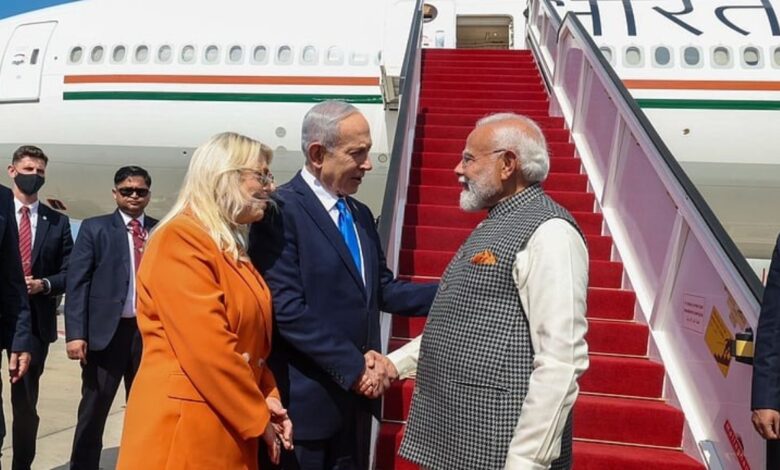
Tel Aviv : Prime Minister Narendra Modi received a grand ceremonial welcome upon his arrival in Israel on Wednesday for a two-day state visit, marking his first visit to the country in nine years. Israeli Prime Minister Benjamin Netanyahu personally received Modi at Ben Gurion Airport, underlining the growing strategic partnership between the two nations.
Prime Minister Modi arrived in Tel Aviv at around 4.15 pm local time after a six-hour flight. As he stepped off the aircraft, he was welcomed with a red-carpet reception and greeted warmly by Netanyahu with a hug, a gesture symbolising the close personal and diplomatic ties between the two leaders. Netanyahu’s wife, Sara Netanyahu, was also present during the reception.
This marks Modi’s second visit to Israel as Prime Minister, following his historic visit in 2017 — the first ever by an Indian Prime Minister. Officials described the current visit as a crucial step toward deepening the India-Israel relationship into a stronger and more comprehensive strategic partnership.


In a significant symbolic gesture, Israel illuminated its Parliament building, the Knesset, in the colours of the Indian national flag — saffron, white, and green — to honour Modi’s visit. The move reflects the importance Israel attaches to its relationship with India and highlights the strengthening diplomatic engagement between the two countries.
Focus on defence, technology and innovation
During the visit, Modi and Netanyahu are expected to hold extensive bilateral talks covering key areas including defence cooperation, cybersecurity, agriculture, water management, trade, and technological innovation. Both sides are also likely to explore new opportunities for collaboration in emerging technologies and scientific research.
In a statement before his departure, Modi said, “I look forward to engaging in discussions with Prime Minister Netanyahu to further strengthen our cooperation in defence, innovation, agriculture, and people-to-people ties. We will also exchange views on regional and global developments of mutual interest.”
The Prime Minister is also scheduled to meet Israeli President Isaac Herzog and address the Israeli Parliament, becoming one of the few Indian leaders to do so. His address is expected to emphasise democratic values, technological cooperation, and shared security interests.
Modi’s visit comes at a time of heightened geopolitical tensions in the Middle East, making the engagement particularly significant. Defence cooperation remains a cornerstone of India-Israel relations, with Israel being one of India’s key defence suppliers.
Over the years, bilateral relations have expanded significantly beyond defence to include trade, agriculture, water conservation, artificial intelligence, and innovation ecosystems.
Diplomatic observers believe the visit will further strengthen ties between the two countries and open new avenues for cooperation, reinforcing India-Israel relations as a vital pillar of regional stability and global strategic engagement.