Transport unions push Bengaluru Chalo as KSRTC braces for showdown over wage demands

Bengaluru : A fresh confrontation appears imminent between Karnataka’s state-run transport corporations and their employees, with transport unions sticking to their call for a “Bengaluru Chalo” protest on January 29, even as KSRTC management signals zero tolerance towards any form of strike or work boycott.
Employees of four transport corporations — KSRTC, BMTC, NWKRTC and KKRTC — have accused the state government of delaying long-pending wage-related commitments, triggering renewed unrest within the sector. The unions are demanding settlement of wage revision arrears for 38 months between January 2020 and February 2023, along with the implementation of a fresh wage agreement from January 1, 2024.


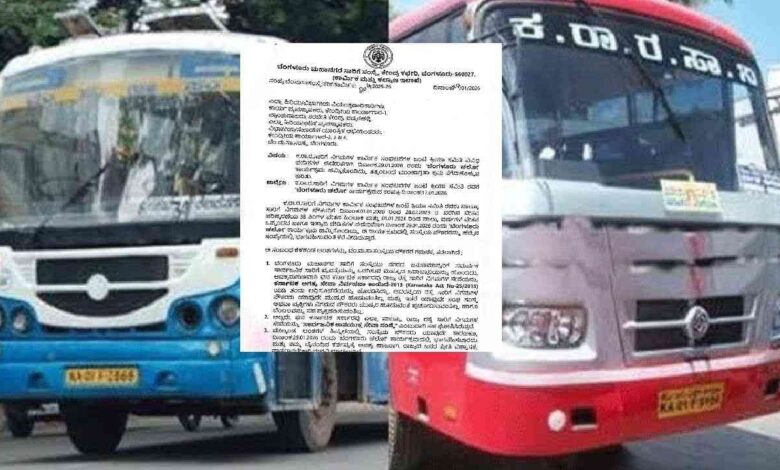
Despite these demands, KSRTC Managing Director Akram Pasha has issued a clear administrative directive stating that transport services must function without disruption. The order bars employees from participating in strikes or supporting the Bengaluru Chalo programme and warns that those who stay away from duty on January 29 will face salary deductions under the “no work, no pay” rule.
Management prepares for uninterrupted services
KSRTC has instructed all divisional controllers and depot managers to ensure full operational readiness on the day of the protest. Leaves have been restricted, and officers have been told to deploy staff efficiently to prevent disruption to bus services. Weekly offs may be cancelled if required, and absenteeism will be closely monitored.
The management has justified the strict measures by citing public interest, stating that lakhs of daily commuters depend on government buses for work, education and healthcare. Any interruption, officials argue, would disproportionately impact the common public.
Unions firm on protest call
Transport unions, however, maintain that the Bengaluru Chalo protest is not a sudden decision but the result of years of unmet assurances. Union leaders claim repeated representations to the government have failed to yield concrete outcomes, leaving employees with no option but collective protest.
They argue that rising living costs and stagnant wages have placed enormous financial strain on transport workers, many of whom worked continuously even during the pandemic. According to union sources, the protest is meant to pressure the government into reopening talks on wage revision and arrears payment.
Commuters caught in the middle
As the standoff intensifies, uncertainty looms over bus operations on January 29. If employees adhere to management instructions, bus services across Bengaluru and other regions are likely to run as usual. However, if a significant section of staff participates in the protest, partial disruptions cannot be ruled out, particularly during peak hours.
Passenger associations have urged both sides to resolve the issue through dialogue, warning that repeated confrontations erode public confidence in public transport systems.
With neither side showing signs of backing down, January 29 could prove to be a crucial test — not just for transport services, but for the government’s ability to balance worker welfare with uninterrupted public services.