NCERT withdraws class 8 textbook after controversy over chapter on judicial corruption

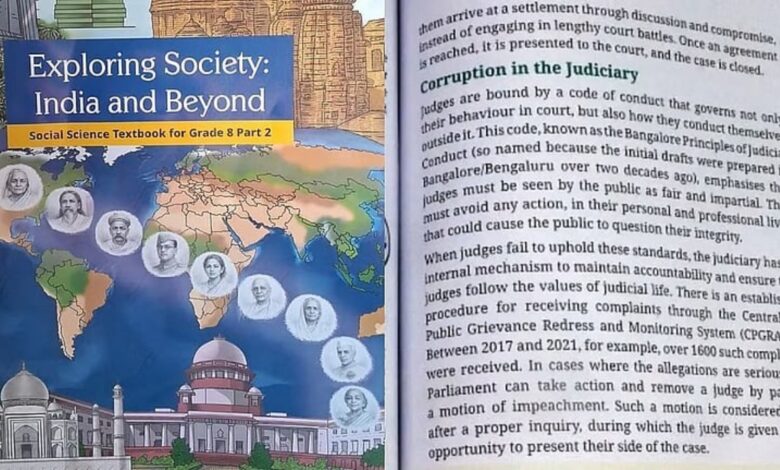
New Delhi: The National Council of Educational Research and Training (NCERT) has withdrawn a Class 8 social science textbook and issued an unconditional public apology after a controversy erupted over a chapter discussing corruption in the judiciary.
The textbook titled Exploring Society: India and Beyond (Grade 8, Part 2) included a chapter called “Role of the Judiciary in Our Society.” The chapter referred to issues such as alleged corruption in the judicial system, the large backlog of pending cases and the shortage of judges as challenges faced by the judiciary in India.
𝐏𝐫𝐞𝐬𝐬 𝐑𝐞𝐥𝐞𝐚𝐬𝐞: 𝐏𝐮𝐛𝐥𝐢𝐜 𝐀𝐩𝐨𝐥𝐨𝐠𝐲
The National Council of Educational Research and Training [NCERT] has recently published a social science textbook, “Exploring Society: India and Beyond," Grade 8 (Part II), which contained Chapter IV titled “The Role of… pic.twitter.com/mZY15aJTDo— NCERT (@ncert) March 10, 2026



Following strong criticism, NCERT announced that the book had been completely withdrawn and would no longer be available in the market. In an official statement, the council’s director and members expressed unconditional regret over the publication and clarified that the textbook had been removed from circulation.
The controversy reached the Supreme Court of India after senior advocates Kapil Sibal and Abhishek Manu Singhvi mentioned the issue for urgent hearing before the court.
A three-judge bench led by Chief Justice Surya Kant, along with Justices Joymalya Bagchi and Vipul M Pancholi, took suo motu cognisance of the matter after objections were raised about what were described as “objectionable references” to the judiciary in the textbook.
During the hearing, the Chief Justice strongly criticised the inclusion of references to judicial corruption in a school-level textbook. The bench observed that no individual or institution should be allowed to undermine the dignity or credibility of the judiciary. The court emphasised that the reputation and integrity of the judicial system must be protected, particularly in educational materials intended for young students.
The Supreme Court also directed that there should be a complete halt to any further publication, reprinting or digital distribution of the controversial textbook. The court noted that the contents of the chapter had the potential to harm the image of the judiciary and create confusion among students.
Meanwhile, the central government also expressed concern over the controversial content. Union Education Minister Dharmendra Pradhan said the government would identify those responsible for preparing the disputed section of the textbook and take appropriate action against them.
The incident has sparked a broader debate on how sensitive institutional issues should be addressed in school curricula while balancing academic discussion and respect for constitutional institutions.