Minister Ashwini Vaishnaw unveils advanced 2-nanometer chip, major boost to semiconductor ambitions

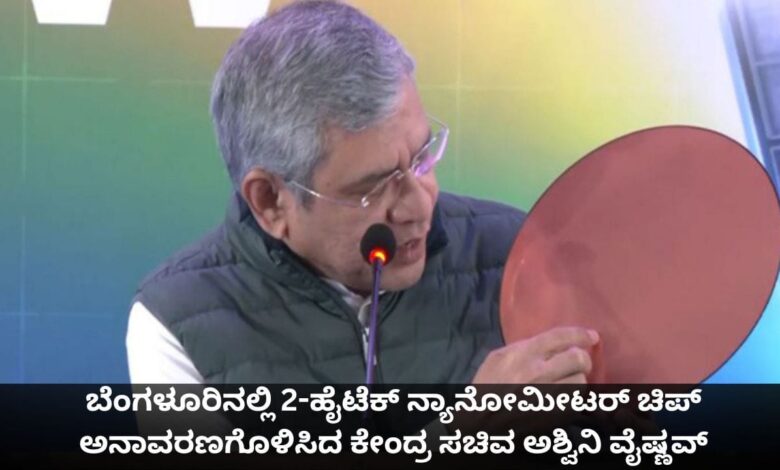
Bengaluru ;Union Minister for Electronics and Information Technology Ashwini Vaishnaw on Saturday unveiled a state-of-the-art 2-nanometer semiconductor chip developed by Qualcomm Technologies in Bengaluru. The launch marks a significant milestone in India’s rapidly growing semiconductor ecosystem and reinforces the country’s ambitions to emerge as a global hub for advanced chip design and innovation.
Addressing the media at the unveiling event, Vaishnaw said India is making remarkable progress in semiconductor technology and is steadily building a strong domestic manufacturing and design industry. “Our country is achieving major breakthroughs in semiconductor production and design. This is becoming a new and important industry in India,” the minister stated while displaying the newly developed chip wafer.
The advanced chip has been designed with major contributions from Qualcomm’s engineering centres located in Bengaluru, Chennai and Hyderabad. According to officials, this collaborative effort highlights India’s increasing importance in global semiconductor innovation and strengthens its position as a preferred destination for high-end technology research and development.


Explaining the technical features of the chip, Vaishnaw said the newly designed wafer contains around 20 to 30 billion transistors. Each small square on the wafer, known as a die, holds nearly 20 billion transistors. The chip integrates both Central Processing Unit (CPU) and Graphics Processing Unit (GPU) capabilities, making it highly powerful and efficient for next-generation computing needs.
“This development proves that India is now at the centre of advanced semiconductor design for the future. It is evidence of the maturity of our design ecosystem. For a country that aspires to build a globally competitive semiconductor industry, this is a very important step,” the minister said.
Vaishnaw also highlighted the progress achieved under the government’s Semicon India Mission. He informed that the mission aims to train 85,000 semiconductor professionals over a decade. So far, nearly 67,000 engineers have already been trained, creating a strong talent pool for the growing industry.
The minister added that semiconductor design education is now available in more than 315 universities and colleges across India. Students from these institutions are actively involved in designing chips and testing them at the Semiconductor Laboratory in Mohali. “Many countries and universities around the world do not have such an integrated model. India is building a unique ecosystem that connects education, research and industry,” he said.
Industry experts believe that the launch of the 2-nanometer chip is a major step towards achieving technological self-reliance and reducing dependence on foreign semiconductor imports. With continued government support and private sector participation, India is set to play a crucial role in the global semiconductor supply chain.