Stone Quarry Rule Violation Brings Rs 3 Crore Fine for Minister Rudrappa Lamani
Stone Quarry rule violations have led the Department of Mines and Geology to impose a Rs 3 crore penalty on Karnataka minister Rudrappa Lamani, along with fines on other quarry owners.

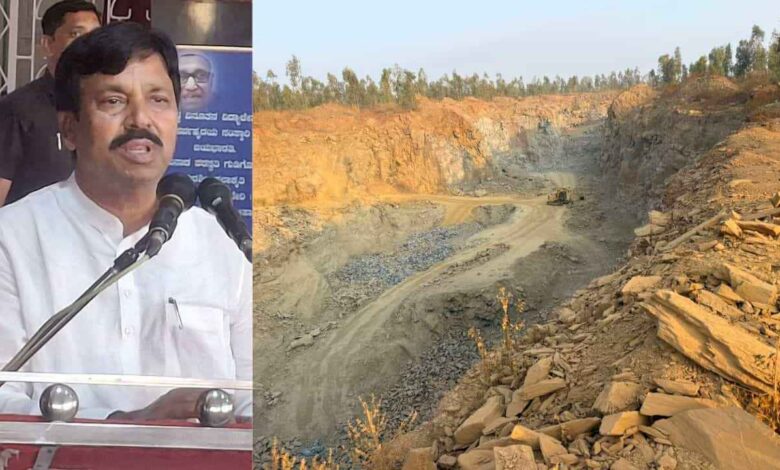
The Department of Mines and Geology has imposed a major penalty on Karnataka minister Rudrappa Lamani following allegations of violations of stone quarry licence conditions in Haveri district.
According to the department notice, Lamani, who owns a quarry near Hunsikatti in Ranebennur taluk, has been directed to pay a penalty of Rs 3 crore. The department has reportedly allowed six months for payment and instructed him to clear the amount in three instalments.
The action is not limited to the minister. More than 60 stone quarry owners in Haveri district have reportedly been issued penalties in connection with similar alleged violations of quarry licence conditions.
The matter came to light after a survey was carried out by the Karnataka State Remote Sensing Applications Centre, commonly known as KSRSAC. Drone based surveying was used to examine quarrying activity in the area and identify possible deviations from permitted boundaries.


Officials reportedly found instances where quarrying had allegedly extended beyond the permitted area. The findings from the survey subsequently became the basis for action against several quarry operators, including Lamani.
The Rs 3 crore penalty imposed on the minister has attracted attention because of his position in the state government. The department has nevertheless treated the case as part of the wider action involving quarry owners in the district.
Under quarry licensing conditions, operators are expected to carry out extraction within the area and terms approved by the authorities. Any deviation from those conditions can lead to action by the concerned department, depending on the nature and extent of the violation.
The use of drone technology has also become significant in the latest action. Remote sensing and aerial surveys can help authorities examine large quarrying areas and compare actual excavation with permitted boundaries. Such technology can make it easier to identify possible encroachment or unauthorised extraction.
The issue has also drawn a response from Basavaraj Belavadi, president of the Haveri District Crusher and Quarry Owners Association. Speaking about the penalty against Lamani, Belavadi said the minister had also faced the same action as other quarry owners.
Belavadi further alleged that quarry owners had been left to deal with the issue on their own and claimed that stronger collective action was needed. He also said Lamani had accepted that the matter involved a violation.
These comments represent the association president’s view and are separate from the department’s official action. The penalty itself follows the findings cited by the Mines and Geology Department after the survey.
For quarry owners in Haveri, the development could also increase attention on compliance with licence conditions. The action against more than 60 operators indicates that authorities are examining quarrying activity beyond a single property.
The six month payment period given to Lamani provides a specific timeline for clearing the penalty. The instruction to make the payment in three instalments also sets out how the department expects the amount to be recovered.
The case highlights the role of regulatory checks in an industry where excavation can significantly alter the land. Monitoring permitted boundaries is therefore an important part of quarry licensing and enforcement.
The department’s action against Lamani and other quarry owners is now likely to keep the issue in focus in Haveri. Further developments will depend on how the affected quarry owners respond to the notices and whether any appeals or other legal proceedings are initiated.