Almatti Reservoir Sees Rising Inflow While KRS Water Level Remains Below 100 Feet
Fresh rainfall in the Western Ghats has increased inflow into the Krishna River boosting Almatti Reservoir while KRS and Kabini continue to record comparatively lower water storage levels.

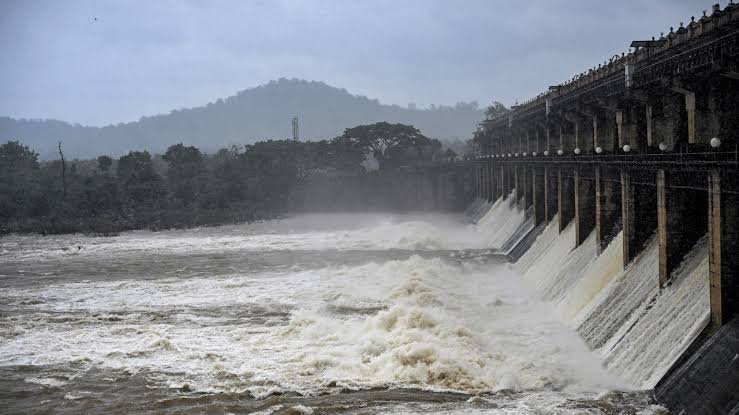
Heavy rainfall over the past few days in the Western Ghats region of Maharashtra has once again increased the flow of the Krishna River, leading to a noticeable rise in water inflow into Karnataka’s Almatti Reservoir. While reservoirs in the Krishna basin are benefiting from the fresh spell of rain, water levels in some of the state’s key reservoirs remain below expectations.
The surge in river flow has been driven by strong inflows from tributaries including the Vedaganga and Dudhganga rivers. Around 80000 cusecs of water is reportedly entering the Krishna River, resulting in several low level bridges in Nipani and Chikkodi taluks being submerged. The Yadur Kallol connecting bridge has gone underwater for the second time during the current monsoon season.
As a result, the Almatti Reservoir, also known as Lal Bahadur Shastri Sagar, has recorded a steady rise in water level. The reservoir currently stands at 518.25 metres against its maximum level of 519.60 metres. It is receiving an inflow of 63792 cusecs, while 25000 cusecs of water is being released downstream to regulate storage.
The Basavasagar Reservoir at Narayanpur in Yadgiri district has also witnessed healthy inflows. The reservoir’s present water level is 489.26 metres compared to its maximum capacity of 492.25 metres. It is receiving an inflow of 14771 cusecs, with an outflow of 6000 cusecs.


Despite the encouraging rainfall in parts of northern Karnataka, the situation at the Krishna Raja Sagara Reservoir remains less reassuring. The KRS reservoir, one of the primary sources of drinking water for Bengaluru and irrigation in the Cauvery basin, has yet to cross the 100 foot mark even as July nears its end.
The current water level at KRS stands at 92.24 feet against its maximum level of 124.80 feet. The reservoir is receiving an inflow of only 852 cusecs, while 1801 cusecs are being released. Its total storage is currently 17.317 TMC compared to its full capacity of 49.452 TMC, highlighting the need for stronger inflows in the coming weeks.
Kabini Reservoir in Mysuru district is also trailing behind last year’s figures. The present water level is 72.65 feet, significantly lower than the 83.63 feet recorded on the same day last year. Water storage currently stands at 13.01 TMC, compared with 19.27 TMC during the corresponding period in the previous year.
The inflow into Kabini has also declined considerably. The reservoir is receiving 3132 cusecs this year, while the corresponding figure last year was 11746 cusecs. Only 500 cusecs of water is being released into the river compared to 12000 cusecs during the same period in the previous year. The catchment area recorded 5 mm of rainfall over the past 24 hours.
Although recent rains have improved water availability in the Krishna basin, reservoir data indicates that several key water sources in Karnataka still require sustained rainfall. With the monsoon season continuing, officials and farmers will closely monitor inflows over the coming days as water storage remains critical for drinking supplies, irrigation and power generation.