PSLV-C62 mission fails after technical glitch, ISRO loses contact with 16 satellites

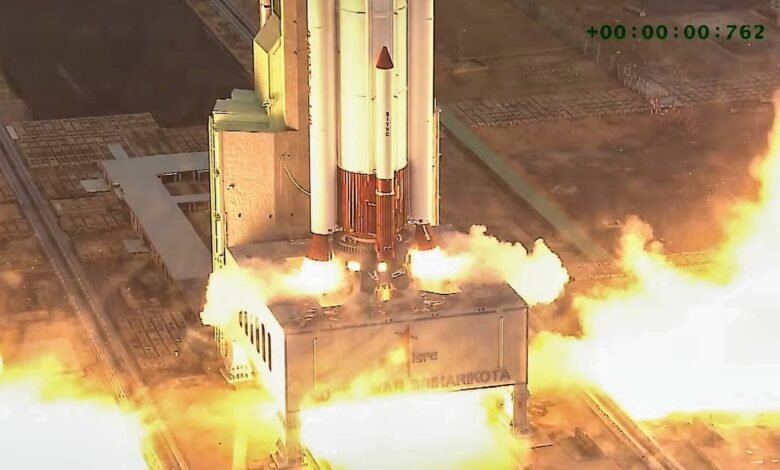
Sriharikota : The Indian Space Research Organisation (ISRO) on Monday announced the failure of its PSLV-C62 mission after a technical malfunction prevented the successful placement of 16 satellites into their intended orbit. The setback marks the first satellite launch failure for ISRO this year and the fifth failure in the otherwise highly reliable Polar Satellite Launch Vehicle (PSLV) programme.
According to ISRO, the mission’s objective of deploying satellites into a Sun-synchronous orbit at an altitude of about 512 kilometres could not be achieved. “The mission to place the satellites into the designated orbit has failed. All 16 satellites have lost contact,” the space agency said in an official statement.
The PSLV-C62 rocket was launched as scheduled at 10.18 am from the Satish Dhawan Space Centre in Sriharikota, Andhra Pradesh. The launch initially progressed as planned, with the first and second stages performing normally. However, a technical anomaly was detected towards the end of the third stage, after which the rocket deviated from its intended trajectory.


ISRO Chairman V Narayanan said that scientists were closely monitoring the mission in real time and that all parameters appeared nominal during the early phases of the launch. “A technical issue was observed towards the end of the third stage, following which the mission could not be completed as planned. We are analysing the available data to identify the exact cause of the anomaly,” he said.
The PSLV-C62 mission was carrying a diverse payload of 16 satellites developed by multiple international and private entities. These included an Earth observation satellite jointly developed by organisations from Thailand and the United Kingdom, five satellites from Indian private space firm Dhruva Space, five satellites from Brazil, and individual satellites from institutions in the UK, Nepal, India, Spain and France. The mission underlined ISRO’s growing role as a cost-effective launch provider for global and commercial space ventures.
PSLV has long been regarded as ISRO’s most dependable launch vehicle and has been used for major missions such as Chandrayaan-1, Mangalyaan, and Aditya-L1. Since its debut, PSLV has been launched 64 times, with only a handful of failures. The last failure occurred on May 25 last year, when the PSLV-C61 mission also failed to place its payload into the intended orbit.
Despite the setback, ISRO officials maintained that lessons from the failure would strengthen future missions. A detailed failure analysis committee is expected to be constituted to examine telemetry data and recommend corrective measures.
The failure is seen as a temporary setback for India’s space programme, which has otherwise maintained a strong success record in recent years, particularly in deep space exploration and commercial launches.