Bangladesh President accuses Muhammad Yunus of unconstitutional conspiracy

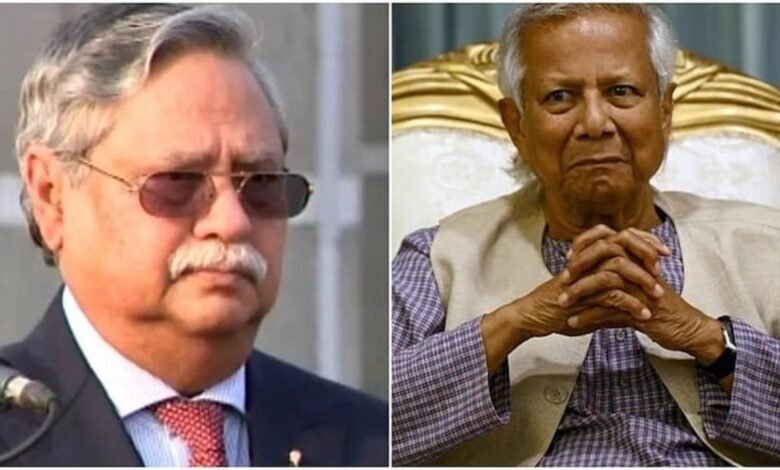
Dhaka: Bangladesh President Mohammed Shahabuddin has levelled serious allegations against Nobel laureate and former Chief Adviser Muhammad Yunus, accusing him of orchestrating an “unconstitutional conspiracy” to remove him from office and destabilise the country.
The remarks come just days after Tarique Rahman assumed leadership of the new government. In an interview to a leading Bengali daily, the President claimed that attempts were made during Yunus’ tenure to create constitutional instability and undermine the office of the President.
“Over the past one and a half years, I was not part of any discussions, yet various conspiracies were hatched against me. There were repeated attempts to permanently damage the country’s peace and order and create a constitutional vacuum,” Shahabuddin said during the interview at Bangabhaban, the official presidential residence in Dhaka.


The President further alleged that Yunus failed to fulfil his “constitutional obligations” by not maintaining required communication with the head of state. He claimed that he was neither informed about foreign visits nor briefed on matters of state importance.
“The Chief Adviser did not follow constitutional provisions. Whenever he travelled abroad, he was required to meet the President upon return and submit a written report. He travelled abroad 14 to 15 times, but not once did he brief me. He never came to meet me,” Shahabuddin said.
Describing himself as a “prisoner in the palace,” the President alleged that two of his planned foreign visits to Kosovo and Qatar were blocked by the Yunus administration. He also questioned the issuance of as many as 133 ordinances during the interim government’s tenure, stating that while ordinances may be necessary under certain circumstances, such a high number lacked justification.
When asked about a reported agreement signed with the United States ahead of elections, Shahabuddin said he had no knowledge of it. “I was not informed—neither orally nor in writing. It was a constitutional obligation to inform the President about such agreements,” he said.
In a striking claim, Shahabuddin alleged that at one stage there was an attempt to bring in a former Chief Justice through unconstitutional means to replace him. However, he said, the proposal was declined citing constitutional constraints.
Referring to protests outside Bangabhaban on October 22, 2024, he described it as a “terrifying night,” alleging that mobs were mobilised and attempts were made to storm the presidential residence before the situation was brought under control with military deployment.
The President said the Bangladesh Army and the leadership of the Bangladesh Nationalist Party (BNP) supported constitutional continuity. According to him, service chiefs assured that any attempt to undermine the President would be resisted.
The allegations have triggered fresh political tensions in Bangladesh, raising questions about the power struggle within the country’s transitional political framework.