Why a Heavy Jamun Harvest Has Farmers Talking About Drought Again
A record Jamun harvest has delighted farmers in Kolar but revived an old rural belief linking abundant fruit production with drought raising curiosity about tradition and changing weather patterns.

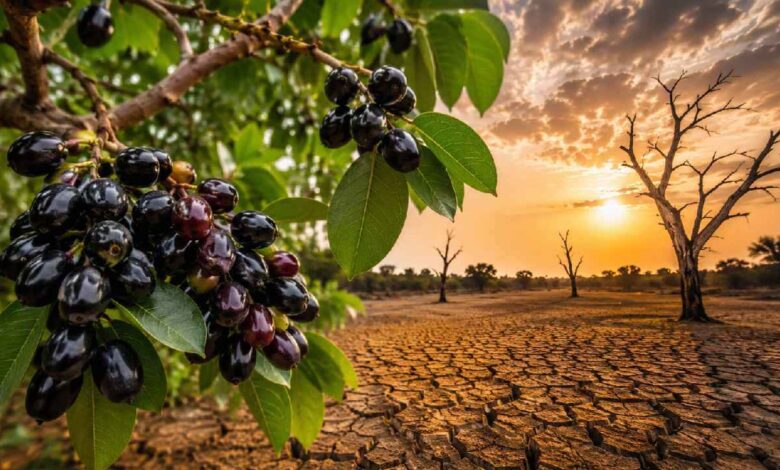
A plentiful Jamun harvest has brought smiles to farmers across Karnataka’s Kolar district, but it has also revived an age old belief that continues to spark debate in rural communities. Many villagers believe that when Jamun trees produce an exceptionally heavy crop, the region is likely to experience a drought during the same year. As rainfall remains below expectations in several areas, the traditional saying has once again become a topic of discussion.
Kolar is widely known for its mango orchards, tomato cultivation, silk production, and dairy farming. In recent years, however, Jamun cultivation has emerged as another promising agricultural activity in the district. What was once grown mainly as a border crop has now expanded into dedicated orchards covering more than 100 acres, with farmers adopting dryland farming methods to cultivate the fruit successfully.
This year’s harvest has exceeded expectations. Farmers report that Jamun trees have produced an abundant yield, allowing them to earn better returns than anticipated. The fruit, valued for its nutritional and medicinal properties, is currently fetching between Rs 200 and Rs 250 per kilogram in the market, making it a profitable crop for many growers.
Despite the positive market response, conversations in villages have shifted toward an old belief passed down through generations. According to local folklore, a bumper Jamun crop is considered a sign that rainfall may be scarce and drought conditions could follow. While there is no scientific evidence supporting this claim, the coincidence between this year’s excellent harvest and delayed monsoon rainfall has prompted many people to revisit the traditional saying.

The timing has added to the speculation. With June coming to an end and monsoon rains arriving later than expected in several parts of the district, sowing activities have also been delayed. For many farmers, the combination of abundant Jamun production and uncertain weather has made the old belief appear relevant once again, even if it may simply be a coincidence.
Agricultural experts and experienced farmers, however, urge people not to rely solely on traditional beliefs when assessing weather conditions. They point out that rainfall patterns are influenced by complex climatic systems, and no single crop or tree can accurately predict drought or seasonal changes.
Organic farmer Chandrashekhar believes the discussion should instead focus on environmental conservation. He says that protecting forests, planting more trees, and promoting sustainable farming practices are far more important than interpreting natural events as signs of future weather. According to him, healthier ecosystems can help reduce the impact of climate related challenges over the long term.
Demand for Jamun has increased steadily in recent years because many consumers associate the fruit with various health benefits, particularly for people managing blood sugar levels. This growing popularity has encouraged more farmers to invest in its cultivation, turning the crop into an attractive source of additional income.
While the old belief continues to be shared across villages, there is no scientific proof that a rich Jamun harvest predicts drought. Nevertheless, the unusual combination of a record crop and delayed rainfall has kept the conversation alive among farming communities. For now, growers remain hopeful that the monsoon will strengthen in the coming weeks, allowing both traditional crops and newly planted fields to benefit from timely rainfall.