Netherlands PM Dick Schoof Visits Bengaluru Traffic Museum and Experience Centre

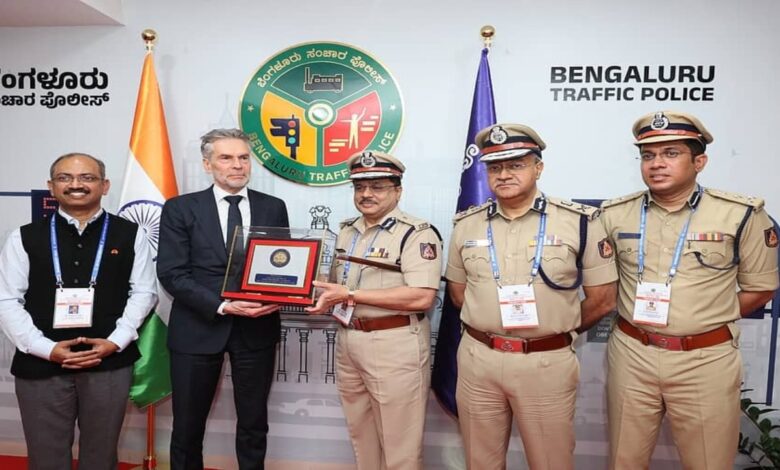
Bengaluru: Netherlands Prime Minister Dick Schoof on Friday visited the ‘Traffic Police Museum and Experience Centre’ set up on the first floor of the Traffic Management Centre on Infantry Road, gaining insights into the evolution of traffic policing in the city.
Before touring the museum, the Prime Minister was briefed by senior officers of the Karnataka State Police on Bengaluru’s traffic management systems. Director General and Inspector General of Police M.A. Saleem, Bengaluru City Police Commissioner Seemanth Kumar Singh, and Joint Commissioner of Police (Traffic) Kartik Reddy welcomed the visiting dignitary and explained various initiatives undertaken to streamline urban mobility.
Officials highlighted measures adopted to manage traffic congestion, ensure smoother vehicular movement, and enhance road safety across the city. Detailed presentations were made on technology-driven interventions, including artificial intelligence-enabled traffic signals, AI-based surveillance cameras, and the functioning of the Integrated Command and Control Centre.
According to Joint Commissioner Kartik Reddy, the Prime Minister was informed about how real-time data analytics and automated monitoring systems help regulate junctions and detect violations. The advanced systems are designed to optimise signal timings, reduce bottlenecks, and improve enforcement efficiency.

At the museum and experience centre, Dick Schoof explored archival photographs and exhibits tracing the journey of Bengaluru’s traffic police. The displays illustrate how traffic regulation evolved from manual hand signals at busy intersections to today’s AI-powered monitoring network.
Historic photographs showcased traffic constables standing atop two-foot-high platforms at major junctions in the early years to direct vehicles. Exhibits also featured the introduction of traffic kiosks in 1970 and images from 1976 depicting a traffic constable managing congestion at the Nrupathunga Road junction.
The museum offers a visual timeline of uniforms, equipment, signalling systems, and junction management practices from earlier decades. From hand-operated traffic control to smart city surveillance infrastructure, the centre presents a comprehensive narrative of Bengaluru’s transformation in traffic administration.
The visit underscores growing international interest in Bengaluru’s technology-integrated urban management systems, particularly in addressing congestion challenges in rapidly expanding metropolitan cities.