Karnataka Reservoirs Hit Six Year Low as Water Storage Falls Sharply Across State
Water storage in Karnataka reservoirs has dropped to the second lowest level in six years raising concerns over drinking water irrigation and rainfall shortages across major river basins

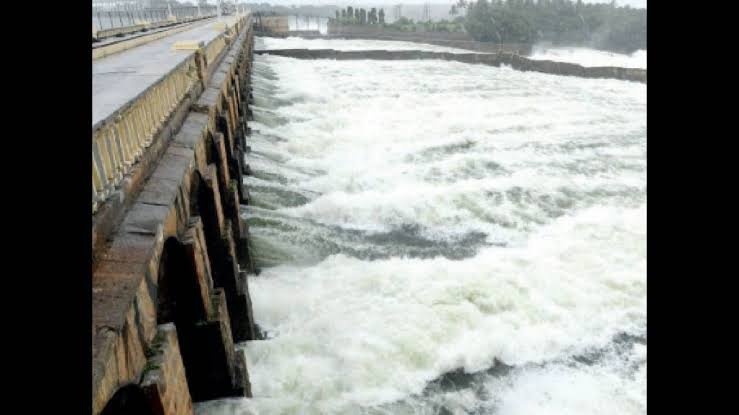
Karnataka is witnessing a worrying decline in reservoir water levels, with storage across the state’s major dams falling to the second lowest level recorded in the past six years. The situation is particularly alarming in the Cauvery basin, where poor rainfall has significantly reduced inflows, raising concerns over future drinking water supplies and irrigation needs.
As of July 24, the state’s 14 major reservoirs together held only 419.35 TMC of water against their total storage capacity of 895.69 TMC. While the figure is higher than the severe drought year of 2023, when storage stood at 371.07 TMC during the same period, it remains one of the lowest levels recorded in recent years.
Most reservoirs have reported a decline of nearly 25 to 30 percent in water storage compared with the corresponding period last year. Almatti remains the only major reservoir showing relatively healthy storage, currently holding 106.33 TMC, largely due to better rainfall in the Western Ghats region of Maharashtra that boosted inflows into the Krishna basin.
The Cauvery basin continues to be the biggest area of concern. Reservoirs including Krishna Raja Sagara, Kabini, Hemavathi and Harangi have received significantly lower inflows this monsoon. Among them, Harangi is the only reservoir maintaining a comparatively comfortable position, with 7.58 TMC of water against its total capacity of 8.50 TMC.


The situation at the Krishna Raja Sagara reservoir has become particularly serious. While the reservoir stored 48.06 TMC of water during the same period last year, the current storage has fallen to just 17.13 TMC. Even during the drought year of 2023, the reservoir contained 19.34 TMC, highlighting the severity of this year’s shortage.
Officials attribute the decline mainly to below normal rainfall across the Cauvery catchment districts. Kodagu has recorded a rainfall deficit of 45 percent, Mysuru 58 percent, Chikkamagaluru 42 percent, Hassan 33 percent and Mandya 27 percent. The prolonged shortfall has directly affected inflows into key reservoirs supplying both irrigation and drinking water.
Rainfall deficits have also affected reservoirs in the Krishna basin, including Bhadra, Tungabhadra, Ghataprabha, Malaprabha and Narayanapura. Although Ghataprabha received improved inflows during July, its storage remained at only 27.24 TMC compared with 46.35 TMC during the same period last year.
Tungabhadra reservoir, where crest gates were recently replaced, is also facing low storage levels. It currently contains only 29.47 TMC against its full capacity of 105.79 TMC, a sharp decline from 78.24 TMC recorded a year ago.
Hydropower reservoirs are facing similar challenges. Linganamakki, the state’s largest reservoir, currently holds just 38.76 TMC against its total capacity of 151.75 TMC. Reports indicate that this is nearly 10 TMC lower than the storage recorded during the drought year of 2023. Supa reservoir is also well below capacity, storing only 46.79 TMC, nearly 100 TMC short of its maximum capacity.
Experts have expressed concern that if rainfall does not improve in the coming weeks, water availability for both agriculture and urban consumption could come under pressure. Former India Meteorological Department Director General Dr K J Ramesh noted that reservoirs are designed to meet drinking water requirements for two years and support at least one agricultural season. However, he observed that inadequate planning and frequent releases for summer crops are causing reservoirs to deplete earlier than expected, increasing the risk of water shortages during the next season.