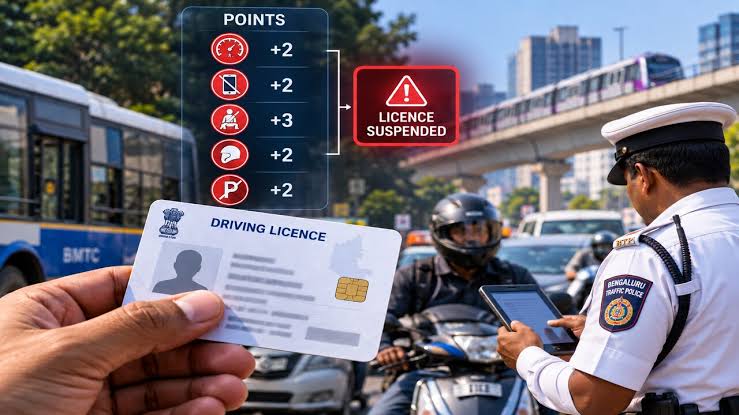
Karnataka is considering a new point based system to deal with repeated traffic rule violations, along with higher penalties for offences that affect road safety and traffic movement. The proposals were discussed during a joint review meeting of the Home and Transport departments in Bengaluru on September 30.
Under the proposed system, different traffic violations would carry a specific number of points. If a motorist reaches a prescribed limit, the driving licence could be suspended. Officials are also examining the legal and regulatory changes that would be required before such a system can be introduced.
The meeting was attended by Home Minister Priyank Kharge and Transport Minister Byrathi Suresh, along with senior officials. The broader discussion focused on traffic congestion, road safety and ways to improve enforcement in Bengaluru and other parts of Karnataka.
A major part of the proposal involves connecting the Transport Departments Sarathi platform with the Bengaluru Traffic Polices e Challan system. Once integrated, traffic officers could verify a driving licences validity, check previous violations and connect a newly recorded offence with the motorists digital record.
The proposed digital connection could also reduce paperwork during enforcement. Instead of treating every traffic offence as an isolated case, officials would have access to a more complete record of a motorists previous violations. The government is examining this as part of a wider effort to strengthen enforcement against repeat offenders.
Higher fines were also discussed for several violations that can create safety risks or obstruct traffic. These include parking on footpaths, driving against traffic on one way roads, driving on pedestrian paths, unauthorised parking, parking in no parking areas and ignoring traffic signals. Penalties for repeatedly committing such offences are also being considered.
Dangerous driving by two wheelers was another issue discussed at the meeting. Officials considered whether stronger penalties should apply to such violations, particularly where driving behaviour creates risks for other road users.
The government is also considering additional action against motorists who repeatedly violate traffic rules. Officials have discussed identifying people with five or more recorded violations and examining measures such as recovery of pending fines, vehicle impounding or blacklisting where legally applicable.
Road safety training for repeat offenders is another proposal under consideration. Drivers whose licences are suspended or cancelled could be required to complete safety and defensive driving programmes before their driving records are restored, with completion details maintained digitally.
The meeting also covered concerns beyond ordinary traffic violations. Officials discussed action against the production and sale of substandard half helmets, as well as unauthorised horns, modified silencers and excessively bright LED lights. These issues were considered in the context of road safety and traffic enforcement.
Low speed electric two wheelers were also part of the discussions. The government is considering appropriate traffic regulations for these vehicles, including measures to identify the vehicles and establish clearer responsibility for riders. The proposal comes amid discussions about bringing greater consistency to traffic enforcement.
The review meeting also considered measures related to shared mobility and public transport. A proposed One City One Fare policy was discussed, along with a state level framework for app based car pooling and ride sharing services. Park and ride facilities were also considered as a way to encourage commuters to use public transport and reduce private vehicle use.
The proposals are still under consideration and do not by themselves mean that the new point based licence system or higher fines have already come into force. Any changes requiring amendments to existing laws or rules would need to follow the relevant legal and administrative process.
If implemented, the point based approach would change how repeated traffic offences are tracked by connecting individual violations with a motorists driving record. The proposed Sarathi and e Challan integration is intended to support that process by giving enforcement officials quicker access to licence and violation information.