BJP Questions Congress Over Letterhead Mentioning Constitutional Posts in Karnataka
A fresh political row erupted after Congress listed constitutional positions alongside ministerial appointments prompting BJP leaders to question parliamentary traditions institutional neutrality and democratic conventions across Karnataka today.

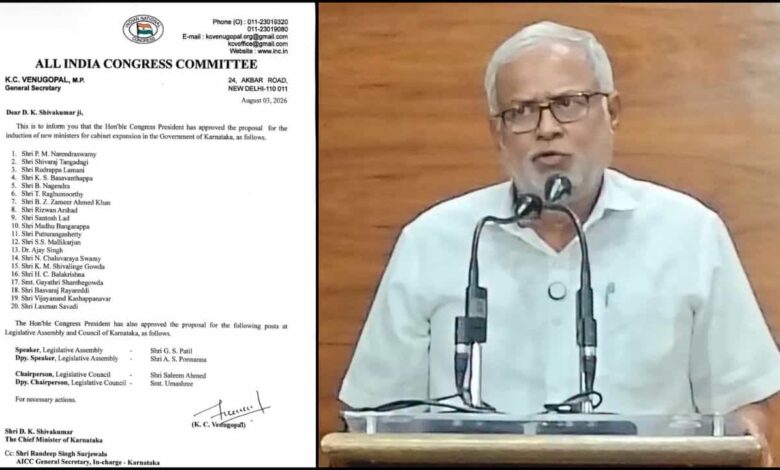
The latest phase of Karnataka’s cabinet expansion has triggered an unexpected political controversy, with the debate shifting from ministerial appointments to the manner in which constitutional positions were mentioned in an official communication issued by the Congress leadership. The issue has drawn strong criticism from the opposition, with senior BJP leader and MLA S Suresh Kumar accusing the ruling party of undermining the neutrality and dignity associated with constitutional offices.
The controversy began after a list released by the Congress high command reportedly included not only the names of legislators expected to join the state cabinet but also references to appointments for constitutional positions such as the Speaker of the Legislative Assembly, the Deputy Speaker, the Chairman of the Legislative Council and the Deputy Chairman. According to the BJP, these names were mentioned on an official Congress party letterhead, a move that has now become the center of a fresh political confrontation.
Suresh Kumar took to social media to express his dissatisfaction, arguing that constitutional offices should remain completely independent of party identity and political influence. He alleged that placing such appointments on an official party document sends the wrong message and creates the impression that these positions fall directly within the control of a political party, despite their constitutional responsibilities.
The BJP leader stated that the offices of the Speaker, Deputy Speaker, Chairman and Deputy Chairman occupy a unique place in India’s parliamentary democracy. Once elected, the individuals holding these posts are expected to function with complete impartiality while protecting legislative procedures and ensuring that all members receive equal treatment inside the House. According to him, these positions are designed to remain above party politics, regardless of the political background of those who occupy them.

He argued that mentioning these constitutional appointments alongside cabinet expansion details on a party letterhead could weaken public confidence in the independence of legislative institutions. In his view, such offices symbolize democratic values, neutrality and institutional integrity rather than party authority.
The criticism also extended to what Suresh Kumar described as a dangerous political precedent. He claimed that, to his knowledge, this was the first instance where the names of individuals expected to occupy constitutional positions had allegedly been communicated through the official letterhead of a ruling political party before the formal legislative process was completed.
According to the BJP MLA, parliamentary traditions require a clear distinction between party decisions and constitutional procedures. While political parties may internally discuss potential candidates for important legislative positions, he maintained that official constitutional appointments should remain separate from party announcements to preserve institutional credibility.
He further alleged that such actions blur the line between political organization and constitutional governance. According to him, democracy functions effectively only when constitutional institutions maintain visible independence from partisan influence.
The cabinet expansion itself had already generated widespread attention across Karnataka. Political observers had been closely monitoring discussions over regional representation, caste balance, administrative experience and internal party equations before the final list of ministers was announced. However, following the release of the appointment document, attention quickly shifted from the new ministers to the controversy surrounding the inclusion of constitutional posts.
Supporters of the ruling Congress have viewed the matter differently, suggesting that the communication reflected internal organizational planning connected with the overall political exercise. Nevertheless, opposition leaders argue that internal planning should not appear to influence offices that are expected to function independently after appointment.
The Speaker of a Legislative Assembly plays one of the most significant roles in parliamentary democracy. The office is responsible for conducting proceedings, maintaining order inside the House, interpreting legislative rules and ensuring that debates are carried out fairly. Although Speakers are usually elected from among legislators belonging to political parties, constitutional practice expects them to discharge their responsibilities without political bias once they assume office.
Similarly, the Deputy Speaker provides support in conducting House proceedings whenever required. In the Legislative Council, the Chairman and Deputy Chairman perform comparable responsibilities while protecting procedural fairness and legislative discipline.
Because of these constitutional responsibilities, critics argue that even symbolic actions associated with these offices deserve careful consideration. Any perception that these positions are directly linked to partisan interests may invite unnecessary political controversy and public debate.
Suresh Kumar also accused the Congress of displaying what he called a contradiction between its public statements and political conduct. He claimed that while the party frequently presents itself as a defender of constitutional values and democratic institutions, actions such as these raise questions about its actual approach toward constitutional independence.
He described the episode as another example of what he believes is inconsistent political messaging. According to him, protecting the Constitution requires not only speeches and public campaigns but also strict adherence to parliamentary traditions and institutional boundaries in administrative practice.
The controversy has once again highlighted the importance of constitutional conventions within India’s parliamentary framework. Although many political decisions originate within party organizations, constitutional offices acquire a distinct identity after appointment and are expected to operate independently of party directives.
Political analysts note that disputes over constitutional procedures often become highly sensitive because they involve public trust in democratic institutions rather than routine political disagreements. Even procedural issues can attract significant attention when they concern offices responsible for maintaining legislative neutrality.
The cabinet expansion remains an important milestone for the Karnataka government as newly appointed ministers prepare to assume their responsibilities. At the same time, the debate surrounding constitutional appointments has added another dimension to the political narrative, ensuring that discussions extend beyond ministerial portfolios.
Whether the controversy leads to further political exchanges or formal responses from the ruling party remains to be seen. For now, the opposition continues to insist that constitutional offices must remain visibly separate from party communications, while the latest developments have sparked broader discussions about parliamentary conventions, legislative neutrality and institutional dignity in Karnataka’s political landscape.