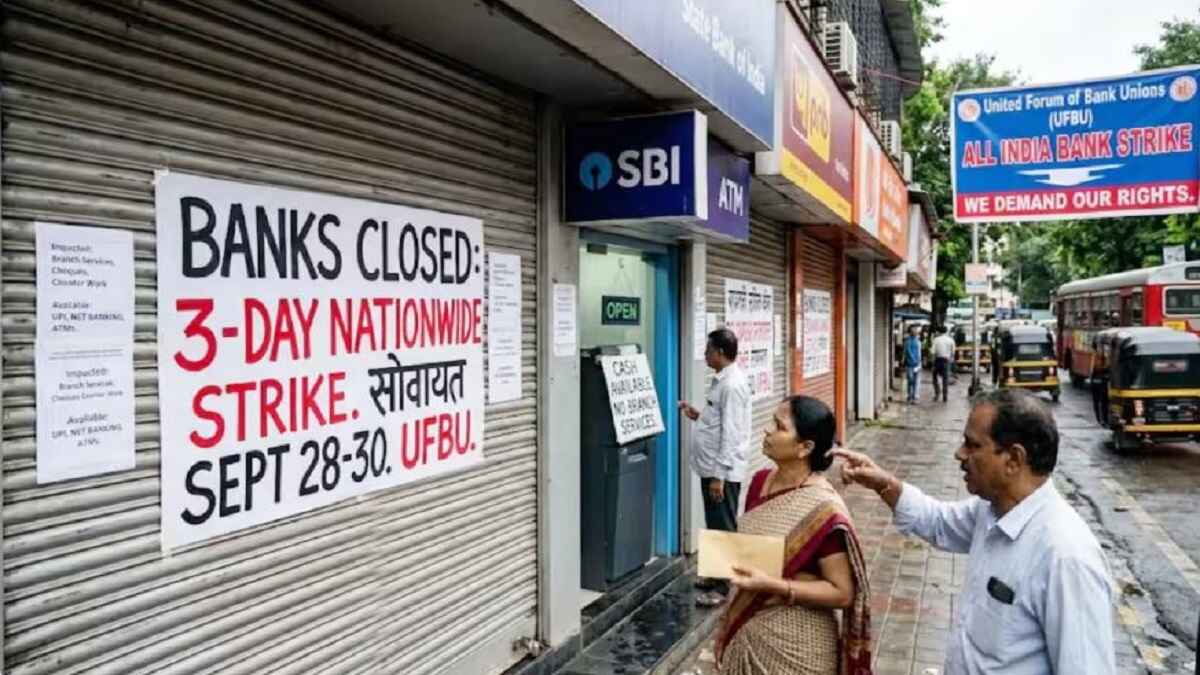
Bank customers across India are set to face major inconvenience next week as bank unions have announced a three-day nationwide strike beginning Monday. The strike is expected to disrupt several banking services, including cheque clearance and over-the-counter cash transactions, making it essential for customers to plan their banking activities in advance.
To minimize inconvenience, the Central Government has directed banks to remain open on Sunday, September 27, allowing customers to complete urgent banking work before the strike begins.
The nationwide bank strike will be observed from Monday, September 28, to Wednesday, September 30. The primary demand of bank employees is the implementation of a five-day work week. Currently, banks remain closed only on the second and fourth Saturdays, while employees are demanding holidays on all Saturdays.
The United Forum of Bank Unions (UFBU), representing seven bank unions and nearly 800,000 employees, has called for the three-day nationwide strike. The organisation has also warned that if its demands are not met, it will launch an indefinite strike from October 26.
The UFBU claims to represent nearly 90% of the country’s banking workforce. Its key demands include:
1.Introduction of a five-day banking week.
2.Revision of the Performance Linked Incentive (PLI) scheme.
3.Fresh discussions on pending issues.
4.Resolution of other long-standing employee concerns.
Although the Indian Banks’ Association (IBA) had earlier agreed to the five-day work week proposal and forwarded it to the government, the matter has reportedly remained pending for nearly two years.
Bank employees have stated that they are willing to work longer hours from Monday to Friday if all Saturdays are declared holidays, insisting that customer service will not be affected. They also argue that an agreement on the issue had been reached in March 2024, but it has yet to be implemented.
Another major concern is the newly introduced Performance Linked Incentive (PLI) policy. Employee unions claim the scheme primarily benefits senior officials while excluding junior and mid-level staff.
Which Banking Services Will Be Affected?
Since September 30 marks the end of the banks’ half-yearly financial closing, the strike is expected to have a significant impact on banking operations.
1.Cash deposits and withdrawals at bank branches.
2.Cheque clearance.
3.Demand Draft (DD) issuance.
4.Opening new bank accounts.
5.Locker services.
Other branch-based services requiring staff assistance.
Government-owned banks are expected to be the most affected, while the impact on many private banks may be comparatively limited.
Customers can continue using the following digital banking services throughout the strike:
1.UPI payment platforms such as Google Pay, PhonePe, and BHIM.
2.Mobile banking applications, including SBI YONO.
3.Internet banking.
4.ATM services.
Banks have also been instructed to ensure that ATMs remain adequately stocked with cash.
Why Will Banks Be Open on Sunday?
Although banks usually remain closed on Sundays, all Public Sector Banks and Regional Rural Banks (RRBs) will remain open on Sunday, September 27, ahead of the strike. The decision was taken jointly by the Finance Ministry and the Reserve Bank of India (RBI) to prevent customers from facing an extended disruption in banking services.
Without this arrangement, customers would have struggled to access banking services for several consecutive days due to the Sunday holiday followed by the three-day strike.
The government has urged bank unions to continue dialogue instead of proceeding with the strike. It has also directed banks to ensure that ATMs remain fully operational with sufficient cash availability.
During conciliation meetings, the government reportedly agreed to temporarily keep the PLI scheme on hold. However, it stated that the demand for a five-day banking week is still under examination and no timeline has been set for its implementation.
The government further said it has already taken several measures for the welfare of bank employees.
As the strike coincides with the month-end salary cycle, the Finance Ministry has instructed banks to credit September salaries and pensions in advance for
Central Government employees.
Defence personnel.
Postal Department employees.
Pensioners.
The move aims to ensure that salary and pension payments are not delayed due to the nationwide strike. Customers are strongly advised to complete important branch-related banking work before September 28.
While digital banking services such as UPI, internet banking, mobile banking, and ATMs will remain available, most branch-based services—including cheque clearance, cash transactions, account opening, and locker operations—are likely to face significant disruption during the three-day nationwide strike.