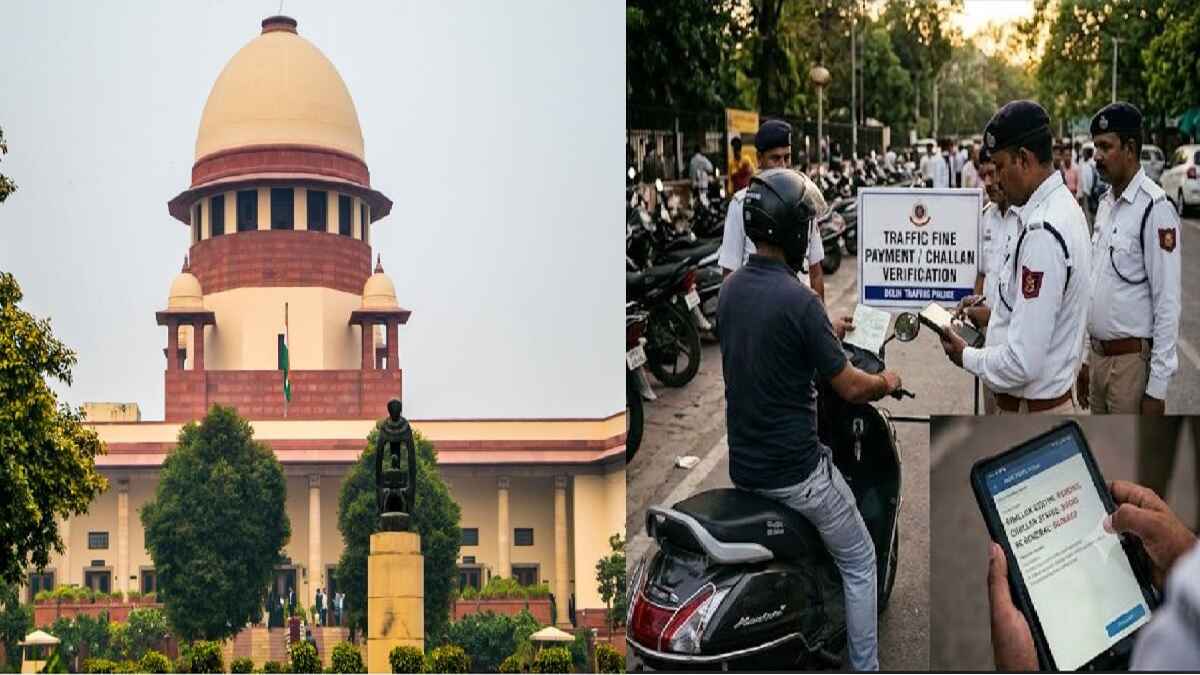
The Supreme Court of India has issued strict directions to all states and Union Territories to freeze key vehicle-related online services, including registration certificate (RC) renewal, fitness certificate issuance and Pollution Under Control (PUC) certificate services, for vehicle owners who fail to clear their pending traffic fines.
Justice J.B. Pardiwala and Justice K.V. Viswanathan passed the order, directing authorities to blacklist vehicles with unpaid e-challans on the central government’s Parivahan portal to prevent their sale or transfer.
The court observed that merely generating lakhs of e-challans serves no purpose unless authorities ensure the recovery of the pending penalty amounts. The court was informed that a total of Rs 49,194.05 crore in traffic fines remain unpaid through various e-challans, while only Rs 26,175.05 crore has been recovered so far.
Following the Supreme Court’s directive, vehicle owners with pending traffic fines may face major difficulties in accessing several online transport services. Authorities will not process requests related to RC renewal, duplicate registration certificates, change of vehicle ownership address, fitness certificate issuance, vehicle sale or transfer until the outstanding fines are cleared.
The order also states that PUC certificates will not be issued at any centre for vehicles with unpaid traffic penalties until the dues are settled. The Supreme Court has further directed authorities to take necessary action in cases involving repeated traffic violations.
This includes suspending the renewal of driving licences and initiating steps to cancel existing licences of habitual offenders. The bench noted that under the amended Rule 21(25), implemented in 2026, committing five or more offences or violations under the Motor Vehicles Act within a year can be considered dangerous or harmful to public safety.
The directions were issued during the hearing of a long-pending road safety case. The Supreme Court emphasised that electronic enforcement systems should not be limited to merely generating e-challans but must ensure effective recovery of penalties.
The court has directed all states and Union Territories to strictly implement the Standard Operating Procedure (SOP) prepared by the Ministry of Road Transport and Highways (MoRTH) to ensure effective enforcement of traffic rules and improve road safety.
Authorities have also been instructed to conduct random vehicle inspections on roads and take necessary action, including vehicle seizure, if they find vehicles with pending e-challans.