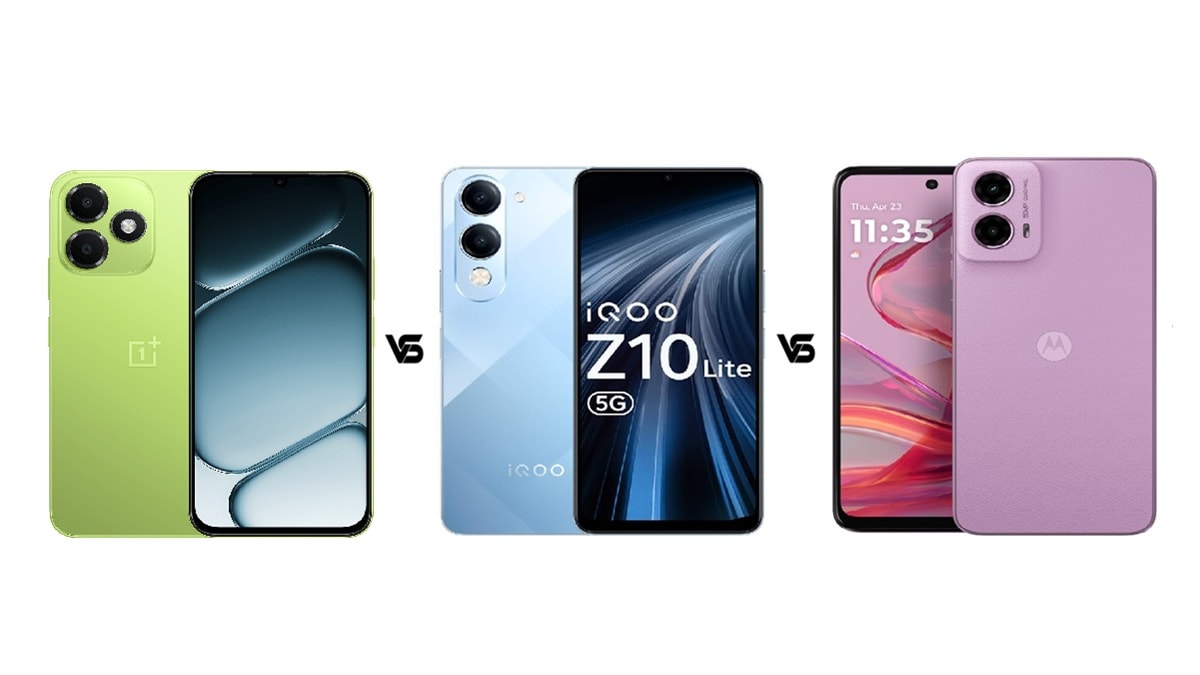
The budget smartphone segment has several options for buyers who want 5G connectivity without moving into higher price categories. Among the recent choices, the OnePlus N6 Lite, iQOO Z10 Lite 5G and Samsung Galaxy A06 5G stand out with different hardware combinations.
The three phones are priced fairly close to one another, but their specifications are not identical. OnePlus focuses heavily on battery capacity, iQOO gives more attention to its camera hardware and Samsung brings a larger selfie camera along with faster charging.
The OnePlus N6 Lite starts at Rs 16,999 for the 4GB RAM and 64GB storage model. The iQOO Z10 Lite 5G costs Rs 16,997 for its 4GB RAM and 128GB storage version. Samsung Galaxy A06 5G is priced at Rs 15,499 for the 4GB RAM and 64GB storage configuration.
Display specifications are also different across the three models. The OnePlus N6 Lite has a 6.75 inch HD Plus LCD panel with a resolution of 720 by 1570 pixels. It supports a 120Hz refresh rate and offers peak brightness of up to 900 nits.
The iQOO Z10 Lite 5G comes with a slightly smaller 6.74 inch HD Plus LCD display. It has a resolution of 1600 by 720 pixels, a 20 to 9 aspect ratio and a 90Hz refresh rate. Its peak brightness can reach 1000 nits.
Samsung Galaxy A06 5G features a 6.7 inch HD Plus display with a resolution of 900 by 1600 pixels. The screen can reach up to 800 nits of peak brightness. The display specifications therefore vary considerably even though all three phones sit in a similar price range.
Performance is another area where the phones take different approaches. OnePlus N6 Lite uses the octa core UNISOC T7250 processor. The iQOO Z10 Lite 5G and Samsung Galaxy A06 5G both use MediaTek Dimensity 6300 processors, with the iQOO model using the 6nm version.
Software is another clear difference. The OnePlus N6 Lite runs Android 16 based ColorOS 16. The iQOO Z10 Lite 5G comes with Android 15 based Funtouch OS 15, while the Samsung Galaxy A06 5G runs Android 14.
Battery capacity is one of the strongest differences between the three smartphones. OnePlus N6 Lite carries a 7000mAh battery and supports 15W fast charging. It also supports reverse wired charging, allowing the phone to provide power to compatible devices.
The iQOO Z10 Lite 5G has a 6000mAh battery with 15W fast charging support. Samsung Galaxy A06 5G comes with a 5000mAh battery but supports faster 25W charging.
The camera hardware gives iQOO and Samsung an advantage in terms of primary sensor resolution on paper. OnePlus N6 Lite has a 13MP rear camera with an f2.2 aperture and LED flash.
The iQOO Z10 Lite 5G features a 50MP main rear camera with an f1.8 aperture, supported by a 2MP depth camera. Samsung Galaxy A06 5G also has a 50MP primary rear camera with an f1.8 aperture and a 2MP depth sensor.
For selfies, OnePlus N6 Lite and iQOO Z10 Lite 5G both use 5MP front cameras with an f2.2 aperture. Samsung Galaxy A06 5G has an 8MP front camera, giving it a higher resolution sensor for selfies and video calls.
The physical dimensions also show some differences. OnePlus N6 Lite measures 166.48mm in length, 78.23mm in width and 8.95mm in thickness, with a weight of 215 grams.
The iQOO Z10 Lite 5G measures 167.3mm long, 76.95mm wide and 8.19mm thick. It weighs 202 grams, making it lighter and slimmer than the OnePlus model.
Samsung Galaxy A06 5G measures 171.88mm in length, 77.80mm in width and 8.22mm in thickness. Its weight is 212 grams.
Looking at the specifications as a whole, each phone has a different focus. OnePlus N6 Lite puts a strong emphasis on battery capacity and a higher refresh rate display, while iQOO Z10 Lite 5G combines a 6000mAh battery with a 50MP primary camera and 5G connectivity.
Samsung Galaxy A06 5G comes at the lowest starting price among the three and offers a 50MP rear camera, an 8MP front camera and 25W charging. Its software version, however, is older than the versions offered on the OnePlus and iQOO models.
For buyers comparing these phones, the right choice will depend on which specifications matter most. Battery capacity, camera hardware, charging speed, software version, storage and display refresh rate can all make a difference in everyday use.
The price gap is relatively small, but the storage difference is worth noting. The iQOO model provides 128GB storage at its listed starting price, while the OnePlus and Samsung variants mentioned here offer 64GB.